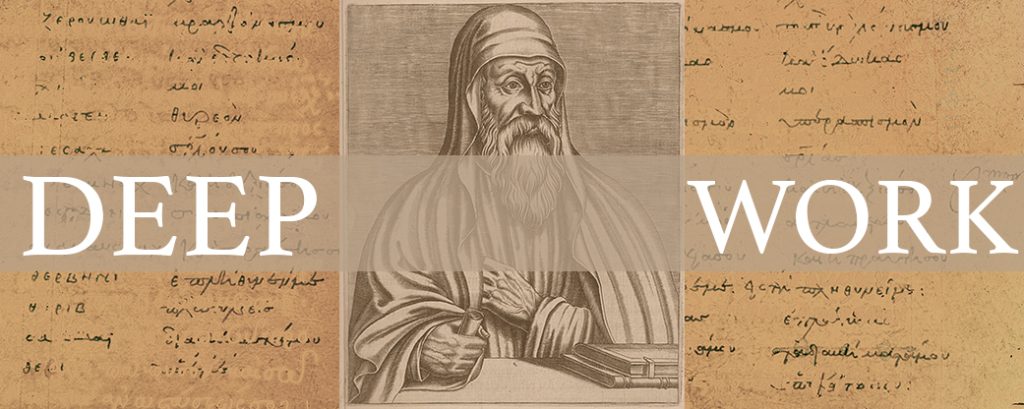
Welcome to the Hexapla Institute’s blog. In this piece, we introduce Origen (185–254), the important church father from Alexandria, Egypt, his Hexapla or six-fold version of the Old Testament, and the Institute that seeks to recover this important version.
Origen of Alexandria
Origen was born to a certain Leonides in Alexandria around 185. Eusebius tells us that his father was beheaded during Roman persecution. Before his death, his father saw that Origen was educated classically in the disciplines of mathematics, grammar, rhetoric, and perhaps most importantly, the Scriptures themselves. Around 204, Origen began leading the catechetical school in Alexandria, a post he held until 232 when he moved to Caesarea. While in Alexandria, he wrote some of his more important works such as On First Principles (a work sketching the Christian underpinnings to theology), Selections on Psalms (an exegetical work), the first part of his John Commentary, etc.
Around 232, he moved to Caesarea in the land of Israel. This move brought Origen into closer contact with the Jews and it is probably not coincidental that he began work on his Hexapla shortly after this move. During this time, Origen wrote numerous sermons on biblical books like Jeremiah in which he references multiple Greek translations of the Old Testament. During the early 240’s, Origen is almost certainly finishing up his work on the Hexapla and therefore has this most significant Bible study tool at his fingertips. Certainly, by the end of the 240’s and the beginning of the 250’s, Origen appears to have long finished his Hexapla and was working on his Matthew Commentary, an apologetic work Against Celsus, and probably finishing another work of textual criticism known as the Tetrapla.
Around 254, Origen died of natural causes. He did not die a martyr’s death, but he probably did succumb to previous injuries and hardships suffered previously due to persecution. His life and work stand as a monument to Christian scholarship in service to the church, and all who come after him are in his debt because of the work left behind.
The Hexapla Institute seeks to recover Origen’s textual work both because that is a good and satisfying goal in itself and the remains of his Hexapla included very important biblical texts that we cannot now access independently unless we recover all the remains of the Hexapla itself. So, what was the Hexapla?
Origen’s Hexapla
The Hexapla (pronounced heksupla) was a six-fold version of the books of the Old Testament. Specifically, it was a version containing six parallel columns: (1) the Hebrew text, (2) the Hebrew text in Greek letters or a Greek transcription of the Hebrew, (3) Aquila’s revision of the Septuagint, (4) Symmachus’ revision of the Septuagint, (5) the Septuagint, and (6) Theodotion’s revision of the Septuagint. The church historian Eusebius tells us that for the Psalms Origen included anonymous versions which he called “the Fifth edition” (Latin: Quinta) and “the Sixth edition” (Latin: Sexta).
This parallel version of the Old Testament allowed its user to read a single version of the Bible vertically down a column or to read all the versions horizontally across the columns. No doubt, the Hexapla was a very useful textual tool to a person wanting to compare the most significant biblical texts and translations with one another. Indeed, early Christian scholars commented on the usefulness of the Hexapla to anyone who would happen upon it.
The Hexapla was not the only text Origen created. Early sources connect his work with a text known as the Tetrapla or “four-fold.” In this case, however, we should not envision a text in four parallel columns. This four-fold version contained a fully corrected text of the Septuagint with readings of Aquila, Symmachus, and Theodotion in its margins—thus, a four-fold version. This text contained critical signs (the asterisk “a star” and obelus “a lance”) to show where Origen added text, usually from Theodotion, to make the Septuagint equal to the Hebrew and also where the Hebrew text was shorter and thus to show where the Septuagint was already longer. Thus, the Tetrapla was a more portable and convenient tool for bible study because it would not have required as much material to create or to copy, and it would have been a more compact edition of the Hexapla. Indeed, this Tetrapla must have been copied quite a lot in the fourth and fifth centuries since at the end of the fourth century, Jerome can already comment to Augustine that scarcely is there a library among the churches that has not been influenced by Origen’s edition of the Old Testament text.
By the middle of the seventh century, the Hexapla that was in the Caesarean Library appears to have been lost or destroyed. There are only a few fragments of the synopsis of Psalms that can be dated after this period showing that maybe Psalms or at least part of Psalms survived and were copied. This reality means that we are attempting to reconstruct the text of a document that has largely been lost. But all is not lost. Before its disappearance, many hexaplaric texts made their way into the margins of manuscripts (Tetrapla and beyond), commentaries by the church fathers, and ancient versions like the Syro-Hexapla and the Latin Vulgate. And that is where the Hexapla Institute enters the story of recovering and preserving Origen’s textual legacy.
The Hexapla Institute
Some of the remains of the Hexapla reached the shores of Europe in the work of Andreas Masius for the book of Joshua in 1571. For the first time, some readings of the Hexapla were made accessible to the western church. From the late 16thcentury, the remains of the Hexapla were printed in editions of the Septuagint, but in 1713, Benard de Montfaucon’s edition, Origenis Hexaplorum quae supersunt (The remains of Origen’s Hexapla) became a watershed moment in Hexapla scholarship as he provided an extensive introduction and a list of the chief sources of the hexaplaric fragments. This edition became the model for Frederick Field’s own edition published in 1875 as he added readings from an important Syriac tradition of the Hexapla known as the Syro-Hexapla.
The Hexapla Institute picks up the torch around the year 2000 and has set out to publish a new edition after the model of Frederick Field’s, which is now over one hundred and fifty years old. Field’s edition has become outdated since significantly more manuscripts and readings of the Hexapla have been discovered since the publication of his work. The Hexapla Institute seeks to publish a new edition for the twenty-first century. This edition will be published in print and digital formats and will include all extant readings of the Hexapla—edited by textual critics with all variants to the text placed in an apparatus. Users of this new edition will be able to see exactly where each reading comes from and be able to follow the editor’s textual decisions for each reading. In previous editions, this access has not always been possible.
We must remember that outside of the remains of the Hexapla, we cannot but with rare exception access the important readings of the Three Jewish revisers, Aquila, Symmachus, and Theodotion. We also cannot access the anonymous editions of the Fifth and Sixth editions or even the more obscure readings known as “The Hebrew” or “the Syrian” outside of the traditions that have preserved these texts of the Bible. Thus, the Hexapla Institute undertakes a very significant project that will bring all of these readings to light in a newly edited collection and make them accessible in print and digital formats. I will say more about the Institute’s database project in a future post.
“Deep Work”
By all accounts, Origen’s industrious and scholarly pursuits required deep work. “Deep Work” as coined by Cal Newport in his book by that title describes the ethos and kind of work for which the Hexapla Institute aims. Newport focuses on the value, rarity, and meaningfulness of deep work and contrasts it with fast-paced Internet related tasks like social media posts and YouTube informational videos. He shows how the latter tasks have become an expectation in knowledge work, but that kind of work produces shallow results. Rather, deep work is inherently valuable, rare, and can generate a meaningful and significant world to inhabit (unlike life on X or Facebook). To create a new critical edition of Origen’s Hexapla, the Institute seeks to develop deep work habits much like a craftsman who insists on forging swords by hand with hammer and anvil as opposed to using less-satisfying methods with machines in a factory.
We plan to produce rare and valuable work efficiently, which will also generate a meaningful world within the work itself. As scholars and craftsmen, we desire to produce a valuable and meaningful critical edition of the Hexaplaric remains for students of the biblical text for a long time to come. Among other meaningful overlaps, this edition will intersect with research into the Scriptures of the church fathers, manuscript studies, Hebrew and Greek lexicography, etc. This critical edition will last for another century and a half and give access to the texts of the Jewish revisers which we could not access in any other way. With such significant work to be done, the Hexapla Institute will not be on social media. The Institute must spend its time gathering and editing the Hexaplaric remains in order to publish its edition efficiently and timely. We will use an email Newsletter as well as the website for sharing updates and developments to the project. We will post about interesting discoveries of our work along the way. But fundamentally, we exist to push back the frontiers of knowledge in this important chapter of the Bible’s history so that we can recover and then grant access to these rare texts that will impart wonderful information to us about how the Bible was copied and interpreted before and after the turn of the era. In a future post, I will present a plan for how we will attempt to complete such a project as well as how we will track and show its progress.
This project is long range in nature. It will take endurance. It will depend on faithful PhD students and an international partnership with other research institutions as well as faithful donors and patrons. Thankfully, today, the Hexapla Institute is now poised to make its contribution and to publish its “New Field for the Twenty-First Century.”